What is Cyberbullying? Cyberbullying is bullying
that takes place using electronic technology. Electronic technology
includes devices and equipment such as cell phones, computers, and
tablets as well as communication tools including social media sites,
text messages, chat, and websites. Examples of cyberbullying include mean text messages or emails,
rumors sent by email or posted on social networking sites, and
embarrassing pictures, videos, websites, or fake profiles. Learn more about the nature cyber bullying by watching the video below.
Next, read about the status of cyberbullying in America today here and check out related statistics below.
What Can We Do? Be an Upstander! If we witness bullying in any form and do nothing, the consequences can be devastating. Watch the video below to understand why being a bystander to bullying can have deadly effects, and why it's vital that we all play a more active role if we see bullying taking place.
Learn more about the importance of being an upstander and not a bystander when it comes to bullying by checking out the information below.
Now put your new understanding of cyberbullying and the role of the upstander to the test by completing the Cyberbullying Activity, which can be found in your Language Arts
Poetry Final ExamOur
unit on poetry is coming to a close and now it's time to demonstrate
what we have learned. Part of today's Poetry Exam will focus on the
three poems featured below. Make sure that you read each poem carefully
and refer back to each poem during the test. You can find your online
Poetry Exam here.
Poem # 1
Poem # 2
Poem # 3
Taking Care of Business TimeFriendly
reminder: Tomorrow is the last day of your 2nd quarter of middle
school! It's the last the day to turn in missing or incomplete
assignments. It's the last day to take A.R. tests and earn points
towards your reading goal. It's the last day to do whatever needs to be
done to get your grades up.
You may use this portion of class today to silent read and take A.R. tests. You may also use this time to review your grades and assignments on School Loop
and figure how to dedicate your energy during these last moments of the 2nd quarter. Additionally, consider messaging teachers if you have
questions or need to inform them of anything related to your assignments
or grades. Homework(1.)Read your A.R. book at home for at least 30 minutes and, if you choose, make a reading log entry using the Digital Reading Log. (Remember you must have made at least two entries by the end of the day Friday.)(2.)Tomorrow, Friday, December18, is the last day of the quarter and the following assignments must be completed and 'turned in' in order to have a chance to receive full credit: Sound Devices in Poetry, Personification in Poetry,Tone and Word Choice in Poetry, and"Oranges" - Sensory Details.
The poem "Oranges" is featured in the book of poetry Fire in My Hands By Gary Soto
Today's Learning Objectives To understand and appreciate poetry and to recognize imagery and its effects.
Students in the NewsSeveral of our own very special students are being recognized for their extraordinary accomplishments this week. Marissa (from Period 2) beat out all other 6th graders to win the Lakeview Spelling Bee. She will now be representing Lakeview at the Santa Cruz County Spelling Bee. Way to go, Marissa!
Also, the talented Colby and Anthony (both from Period 3) have had their short stories selected to appear in creative writing section of Lakeview's very own online student newspaper the Eagle Times. Cogratulations, Colby and Anthony!
"Oranges" by Gary Soto: Noting Sensory DetailsToday we will read the poem "Oranges" by Gary Soto, which is rich with imagery and sensory details.
Remember that writers use sensory details to appeal to a reader's
senses -- sight, hearing, touch, smell, and taste. These details can
help the reader visualize the scene the writer is describing and create
images that evoke feelings within the reader. As we read "Oranges" take note of Gary Soto's use of sensory details using the document "Oranges" - Sensory Details, which can be found in your Language ArtsGoogle Classroom.
Homework(1.)Read your A.R. book at home for at least 30 minutes and, if you choose, make a reading log entry using the Digital Reading Log. (Remember you must have made at least two entries by the end of the day Friday.)(2.)Continue working on the "Oranges" - Sensory Details, which isdue tomorrow, Friday, December18. (3.)Study for tomorrow's Poetry Exam.
Today's Learning Objectives To understand and appreciate poetry and define how tone or meaning is conveyed through word choice. Tone and Word Choice in PoetryThe tone of a poem is the poet's attitude toward his or her subject. You can identify the tone of a poem by paying attention to the images in a poem and to the poet's word choice. More information can be found in the infographic below.
Today
we will read two different poems "Street Corner Flight" and "Words Like
Freedom" with somewhat different tones. Your objective is to try to
figure out the tone or tones of each poem by focusing on the word
choices the poet makes and the images he or she creates. You will record
your analysis using the document Tone and Word Choice in Poetry, which can be found in your Language Arts Google Classroom.
Sacred Reading TimeThere are three days left in the quarter! Have you reached your A.R. goal yet? If not, I'd like to offer you some uninterrupted class time to simply read and
commune with your books today. Some of you will invited to reading a cozy corner of the room, while most of you will hopefully
become enraptured by the words on your pages right at your desks. Enjoy
this time!
Homework(1.)Read your A.R. book at home for at least 30 minutes and, if you choose, make a reading log entry using the Digital Reading Log. (Remember you must have made at least two entries by the end of the day Friday.)(2.)Continue working on the Tone and Word Choice in Poetry, which isdue tomorrow, Friday, December18.
Today's Learning Objectives To understand and appreciate poetry and identify and understand personification.
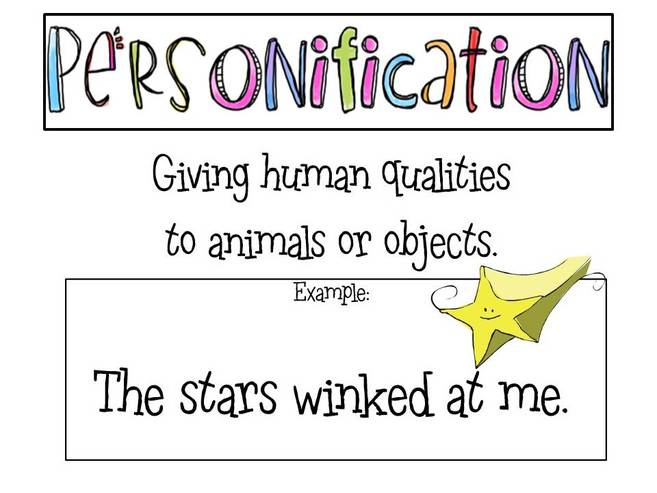
Personification in PoetryWe are going to continue our exploration of poetry today by examining the use of personification in two different poems. For a reminder on what personification is and why poets use it, check out the infographic below.
As
you read today's poems, be on the lookout for personification, as the
poets work to give human qualities to things that are decidedly
non-human. Record your analysis of personification using the document Personification in Poetry, which can be found in your Language Arts Google Classroom.
Newsela Article: "Syrian poet bears witness to years of vicious civil war"
Let's continue to explore poetry, while also examining a powerful Newsela article. Today's article is about Syrians who are using poetry to express their feelings about the brutal civil war there. You can find a link to the article within
your Language Arts Google Classroom.
Homework(1.)Read your A.R. book at home for at least 30 minutes and, if you choose, make a reading log entry using the Digital Reading Log. (Remember you must have made at least two entries by the end of the day Friday.)(2.)Continue working on the Newsela Article and Personification in Poetry, both of which are due tomorrow, Friday, December18.
Video of the Day College is awesome. If you don’t believe me just ask the First Lady of the United States and Saturday Night Lives’s Jay Pharoah.
Sacred Reading TimeI'd like to offer you some uninterrupted class time to simply read and
commune with your books today. Some of you will invited to reading a cozy corner of the room, while most of you will hopefully
become enraptured by the words on your pages right at your desks. Enjoy
this time!
Identifying Similes and Metaphors in Music
Let's spend the remainder of our time today listening and grooving to
our favorite music! However, remember that we also have an academic
purpose for this. Our task today is to identify and analyze the use of
similes and metaphors in some of our favorite songs. As you listen to
each song, record it's title, provide an example of figurative language
featured in the song, indicate whether that example is a simile or
metaphor, explain what is being compared, and include a short analysis
of why you think the songwriter is making the comparison. You can find
the assignment Similes and Metaphors in Music in your Language Arts Google Classroom.
Today's Learning Objectives To understand and appreciate poetry and understand the poet's use of sound devices (rhyme, repetition, rhythm).
Sound Devices in Poetry: OverviewToday
we will read two different poems that rely on various sound devices to
add to the feeling and meaning of the poem. As we read each poem, you
will make note of the various sound devices (rhyme, rhythm, and
repetition) using the document Sound Devices in Poetry,
which can be found in your Language Arts Google Classroom. To understand more
about sound devices in poetry, check out the 'Focus Your Reading'
information below.
Rhyme and Repetition in "Still I Rise" by Maya AngelouWe
will begin today by reading the poem "Still I Rise" by the
extraordinary poet Maya Angelou. Pay close attention to Angelou's use of
rhyme in the poem. Do you think there is significance in
the pairs of words that do rhyme? Also, look out for repetition. Is
there a word or phrase that you see repeated over and over again? Why
might that be significant? How does Angelou's use of rhyme and
repetition add to the overall feeling and meaning of the poem?
Rhythm in "Casey at the Bat" by Ernest Lawrence ThayerNow
we will read the classic baseball poem "Casey at the Bat," which has a
distinct rhythmic quality from start to finish. Do you notice the
pattern of stressed and unstressed syllables employed by Ernest Lawrence
Thayer? How does Thayer's use of rhythm add to the feeling and meaning
of the poem?
Identifying Similes and Metaphors in Music Let's spend the remainder of our time today listening and grooving to our favorite music! However, remember that we also have an academic purpose for this. Our task today is to identify and analyze the use of similes and metaphors in some of our favorite songs. As you listen to each song, record it's title, provide an example of figurative language featured in the song, indicate whether that example is a simile or metaphor, explain what is being compared, and include a short analysis of why you think the songwriter is making the comparison. You can find the assignment Similes and Metaphors in Music in your Language Arts Google Classroom. Homework(1.)Read your A.R. book at home for at least 30 minutes and, if you choose, make a reading log entry using the Digital Reading Log. (Remember you must have made at least two entries by the end of the day Friday.)(2.)Complete the assignments Similes and Metaphors in Poetry and Similes and Metaphors - Independent Practice, both of which are due tomorrow, Friday, December11.(3.) Complete theassignment Sound Devices in Poetry, which will be duenextFriday, December 18.
What do Justin Bieber and a croaking frog have in common? Find out today in the poem "I'm Nobody! Who Are You?" by Emily Dickinson.
Today's Learning Objectives To understand and appreciate poetry and understand the use of figurative language in a poem.
Examining the Use of Similes and Metaphors in PoetryToday
we will read three different poems by three different poets. Our
objective is to try our best to understand and appreciate each poem,
while also going deeper as poet Billy Collins would want us to do.
Each
poem you read today features figurative language, especially similes
and metaphors. As you examine each poem closely, be on the lookout for
the use of similes and metaphors. Additionally, think about what is
being compared in the identified simile or metaphor, how those two
things are alike, why does the poet makes this comparison, and what effect it
has on you the reader? You will record your analysis using the document
Similes and Metaphors in Poetry, which can be found in your Language Arts Google Classroom.
Musical Homework AssignmentPoetry
is not the only place you can find figurative language, such as similes
and metaphors. Songs feature them too. Check out a few examples below.
Tomorrow
we will be examining the use of similes and metaphors in music. One of
your homework assignments tonight is to select one of your favorite
songs that features either a simile, a metaphor, or both. We will be
listening to various songs tomorrow, so make sure your choice is
appropriate for classroom listening. Please share your selection with me
using the Google Form here. You may submit more than one song if you choose. Homework(1.)Read your A.R. book at home for at least 30 minutes and, if you choose, make a reading log entry using the Digital Reading Log. (Remember you must have made at least two entries by the end of the day Friday.)(2.)Find one song that contains a metaphor or simile and share it on Google Form listed above.(3.)Complete the assignments Similes and Metaphors in Poetry and Similes and Metaphors - Independent Practice, both of which are due Friday, December11.
Today's Learning Objectives To understand and appreciate poetry and understand the use of figurative language.
Introduction to PoetryTrying to define poetry is no easy task. You probably
recognize poetry, when you see it, even if you can't really explain what
poetry is. To understand a poem, you need to think about the way the
words look on the page, the way the words sound together, and the
images, or mental pictures, the create.
Poet
Billy Collins, in his aptly titled poem "Introduction to Poetry,
cautions readers against trying to simply understand or "figure out" a
poem's surface meaning, but rather encourages us as readers to go deep
"inside a poem" and feel and experience it. Let's begin today by feeling
and experiencing Billy Collins' poem below.
Key Elements of Poetry: Figurative LanguageTo
truly experience poetry as Billy Collins encourages us to do, we need
to pay attention to the shapes, sounds, and the images in a poem.
Furthermore, we need to understand and appreciate that poetry is
composed of various elements, which include form, sound, imagery, and figurative language.
Today we are going to focus on figurative language, with a special emphasis on similes and metaphors. Let's now read an excerpt from our textbook explaining what figurative language is and some of the various types below.
Next, let's more closely examine metaphors and similes. How are they alike? How are the different? Watch the short video below.
1. Locate your Apps in Google Drive
BrainPop Activities: Similes and MetaphorsNow
we will continue to explore similes and metaphors with our friends Tim
and Moby from BrainPop. First, open your Google Drive. Next, locate your
Apps by clicking the group of small squares towards the top of your
screen similar to the ones pictured to the side. Then, scroll down and
find and click the BrainPop icon.
2. Find and open BrainPop.
3. Search for the 'Similes and Metaphors' Lesson.
Next, type in "Similes and Metaphors" into the search bar, click the lesson,
4. After the video, take the Classic Quiz.
and
the close your computer. I will show the video on the "Big Screen"
first as a whole-class. Afterwards, each of your will be able to check
your understanding by taking the "Classic Quiz."
Independent Practice: Similes and MetaphorsNow
that you have a better idea about what similes and metaphors are, let's
practice constructing some of our own. In your Language Arts Google Classroom,
you will find the assignment Similes and Metaphors - Independent Practice. Complete the similes and metaphors by adding your own words. What you do not finish in class becomes homework. Homework(1.)Read your A.R. book at home for at least 30 minutes and, if you choose, make a reading log entry using the Digital Reading Log. (Remember you must have made at least two entries by the end of the day Friday.)(2.) Complete the assignmentSimiles and Metaphors - Independent Practice, which will be due on Friday, December 11.



 Now put your new understanding of cyberbullying and the role of the upstander to the test by completing the Cyberbullying Activity, which can be found in your Language Arts