Wednesday, November 16, 2016
Vocabulary Quizzing and Sacred Reading
Flocabulary Vocabulary Review Today you will be assessed on your understanding of this past week's Flocabulary vocabulary words. Take a few minutes to review. Your quiz will begin shortly.
Flocabulary Vocabulary Quiz You've learned, practiced, and studied your vocabulary words. Now it's time to show me what you've learned! You can find your Vocabulary Quiz below. Good luck!
Sacred Reading Time While I meet with a few more students individually today to make reading goals, I would like to offer you some class time today to simply read and commune with your new books. Some of you will be invited to read outside, others in a cozy corner of the room, while most of you will hopefully become enraptured by the words on your pages right at your desks. Enjoy this time!
Homework (1.) Read for at least 30 minutes at home each school night. (2.) Complete the assignment Any Small Goodness - American Names (Ch.1), which is due on Friday, November 18.
Monday, November 14, 2016
Introducing the Novel 'Any Small Goodness'
Warm Up: 'The Circuit' Quiz Today you will take a short quiz to demonstrate some of what you learned from the story "The Circuit". You can find the quiz here. If you complete the quiz early, you may silent read or take A.R. quizzes until the rest of your classmates are finished.
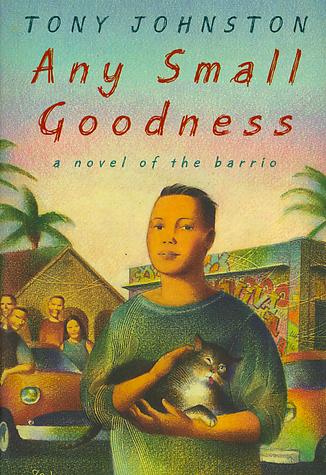
Introducing and Previewing Any Small Goodness Today we are going to begin reading as a class the novel Any Small Goodness by Tony Johnston. The novel features a boy, Arturo, who moves to Los Angeles from Mexico with his family, and describes how Arturo and his family adjust to their new neighborhood. Although life in the new neighborhood presents challenges, Arturo learns about acts of “small goodness” that come to define his experience.
Before we read the novel, however, let's watch a short video about life in East Los Angeles, which serves as the setting of Any Small Goodness. What's the message of this video? How will this portrayal of Los Angeles compare to the one that we are about to explore in the novel?
Our focus as we read is going to be to continue to analyze how the development of characters can help to reveal a story's theme. As we read, pay close attention to Arturo as well as the other characters that make up his East Los Angeles universe, and take note of what their words, actions, and feelings. What lessons do they learn from each other? These may all ultimately be clues to the story's themes.
Lets begin today by previewing the novel Any Small Goodness by using the document Any Small Goodness - Prepare to Read and Character Map, which is located your Social Studies Google Classroom. After previewing the novel, also note how you will use this document to track the characters that Arturo interacts with throughout the novel and the important lessons he learns from them. This document will be used throughout our reading of the novel and is not to be 'turned in' until the end of this unit.
Guided Reading of Any Small Goodness: "American Names" Today we will begin by reading the first chapter of Any Small Goodness, "American Names," together. As we read we will stop periodically to discuss and analyze the text. You will also be using the document Any Small Goodness - American Names (Ch.1) to reflect on and respond to this chapter.
Homework (1.) Read for at least 30 minutes at home each school night. (2.) Complete the assignment Any Small Goodness - American Names (Ch.1), which is due on Friday, November 18.
Wednesday, November 9, 2016
Tuesday, November 8, 2016
The Circuit by Francisco Jiménez
Today's Learning Objective Understand the author's use of description and explain the effects of literary devices (personification, simile, imagery)
Guided Reading: The Circuit Today we will be reading from an excerpt of The Circuit by Francisco Jiménez. You can find the reading selection, beginning on page 4, here.
As we read our job is to pay special attention to Jiménez's use of literary devices. You will use document The Circuit - Literary Devices (in your Language Arts Google Classroom) to make note of the imagery and figurative language, such as similes and personification, that you come across.
Additionally, we are going to use Jiménez's use of figurative language, imagery, and descriptive details to practice visualizing. When you form a mental picture from a description, you are visualizing. You will use the document The Circuit - Visualizing (in your Language Arts Google Classroom) to describe the mental pictures you form form the details in the story.
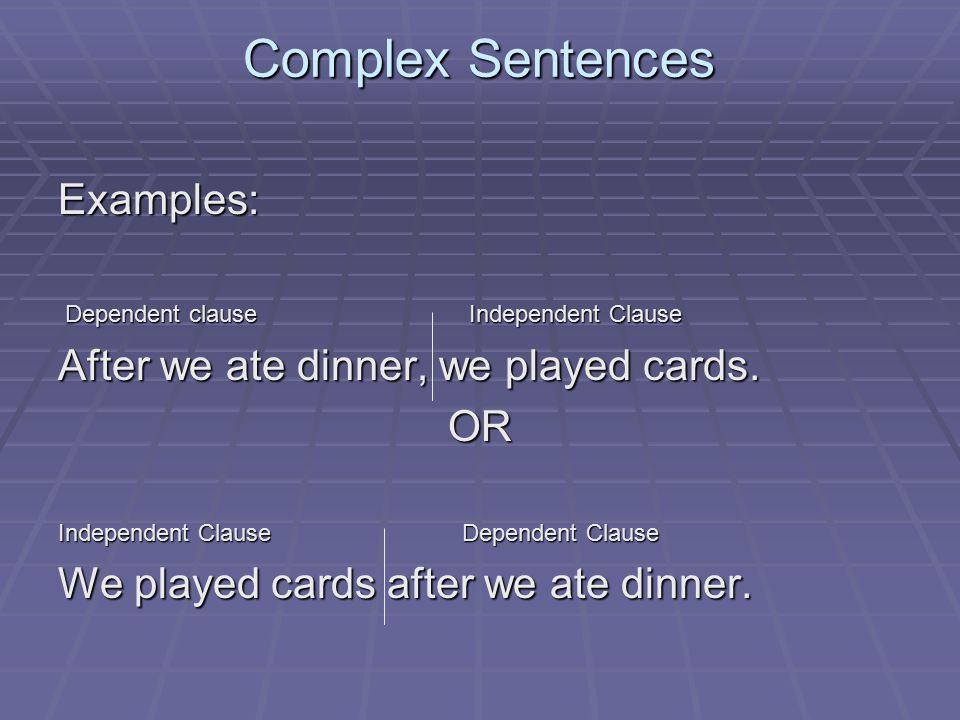
Grammar: 'The Sentence and Its Parts' Quiz Review Tomorrow we will be having a quiz on on 'The Sentence and Its Parts.' Specifically, I will be assessing your ability to identify fragments and run-ons, repair run-on sentences, recognize complex sentences, and differentiate between independent and dependent clauses. In order to prepare, I would recommend reviewing your assignments related to these grammar topics, reviewing pertinent Blog entries, and checking out the information below.
Homework (1.) Read for at least 30 minutes at home each school night. (2.) Continue working on The Circuit - Literary Devices and The Circuit - Visualizing, both of which are due on Friday, November 18. (3.) Study for tomorrow's 'The Sentence and Its Parts' quiz.
Monday, November 7, 2016
Previewing 'The Circuit' and Flocabulary Vocabulary
Today's Learning Objective *Understand the author's use of description and explain the effects of literary devices (personification, simile, imagery). *Use context as a clue to the meaning of a word or phrase.
| Author Francisco Jiménez |
| Francisco (Panchito) Jiménez, as a boy |
To understand a little more about the basic story of The Circuit, watch the video preview below.
Literary Devices One way that good writers, like Francisco Jiménez, make their stories come alive for their readers is by using literary devices, such as imagery, similes, and personification. Literary devices can help readers understand a character's life and surroundings. They also help readers form mental pictures of a story's setting and events.
Today let's focus on similes and personification, which are examples of figurative language. In figurative language, writing goes beyond the actual meanings of words so the reader gains new insights into the objects or subjects in the work. When you describe something by comparing it to something else, for instance, you are using figurative language.
A simile is a comparison of two things that have some quality in common, and usually contains a word such as like, as, resembles, or than. For some examples of similes check out the short video below.
Flocabulary Vocabulary Welcome to Unit 5 of Flocabulary's vocabulary program! This week's lesson "Big Up Yourself" is all about boosting your confidence, and along with it a new set of words to interact with, learn, and hopefully begin to incorporate into our own vocabulary. This week's words are:
dense / deplete / eclipse / eerie / effect / esteem / excel / futile / hazardous / influence / monotonous / prominent / quest / solar / unique
After watching and interacting with the video and song a couple of times, study the words and their meanings with the PDF document Vocabulary - Unit 5 (Big Up Yourself), which can be found in your Language Arts Google Classroom. The accompanying assignment Thinking Creatively ('Big Up Yourself') is also in your Language Arts Google Classroom, and should be completed by Thursday, November 10.
Homework (1.) Read for at least 30 minutes at home each school night. (2.) Continue working on the assignment Thinking Creatively ('Big Up Yourself'), which will be due on Thursday, November 10.
Friday, November 4, 2016
Aloha Friday!
100 Word Challenge: Finishing Touches Before we publish this week's 100 Word Challenge, take another moment to carefully review your writing. Does your story flow naturally from beginning to end? Do you use descriptive words and sensory details? Do you skillfully incorporate dialogue? Do you carefully review your spelling, capitalization, punctuation, and grammar? Do you make sure your verb tenses are consistent and that you have employed correct and varied sentence structures? Please make sure your piece of writing is good as it can be.
100 Word Challenge: Publishing Now it's publishing time! Copy your story from your Google Doc and then login to Kidblog. Make a new post. Give your story an appropriate title. Paste your story. Consider adding a picture. Finally, click 'Publish' and copy the link to your published story. Make sure, however, that when you publish that you make your post "Public," so people around the world can read your story.
Now it's time to share your story with the 100 Word Challenge. In order to login, I will provide you a working Username and Password. Next, fill out the form similar to the one below, making sure to include the link to your Kidblog story. Click 'Submit' when you're done. Congratulations! You are now an internationally published writer!

Once you have published your story, you are welcome to comment on other stories. Your comments, however, should be respectful, specific, and helpful. If you liked something about someone's writing, explain what specific aspect of their writing you appreciated. For example: I loved your use of descriptive details! If you have a tip about how a student could improve their writing, make sure to share in a way that is helpful and not hurtful. For example: I really liked your story, but I thought you could have used a few more sensory details.
It takes a lot of courage to get in front of a group of people. During a reading, the audience should remain attentive and respectful, and afterwards should try to offer positive and constructive feedback. (Some "response stems" for feedback can be found below.)
Kahoot! Activity: Sentence Variety Review Over the past several weeks we have been focused on what a complete sentence looks like, including simple sentences, compound sentences, and complex sentences, as well as how to avoid fragments and run-ons. Today, let's also use Kahoot! to practice understanding sentence variety in order to prepare for a quiz you will have next week.
Thursday, November 3, 2016
Introducing a New Writing Rubric
Introducing a New Writing Rubric for the 100 Word Challenge As we continue to improve and refine our writing this year, I thought it important for us to revisit the way we assess our writing. A rubric can be a powerful tool that defines expectations, informs us about how we are doing, and makes clear our areas of strength and areas that we need to improve upon. I have created a 100 Word Challenge Rubric that provides more specific feedback about various areas related to your writing and more clearly defines what "proficiency" is. Today let's examine the rubric together, clarify its components, and practice using it.
As you can see, for your writing piece to be considered "Proficient" it needs to meet five clearly defined criteria. Let's briefly review these five criteria, as well as some student samples that showcase them.1. Demonstrates command of the conventions of the standard English capitalization, punctuation, and spelling. Does your piece of writing, for the most part, include proper capitalization, punctuation, and spelling? If so, you will receive a point for meeting this criteria. Check out the skillful use of capitalization, punctuation, and spelling in the writing sample below.
2. Uses correct and varied sentence structures. To earn a point here, not only most you form proper sentences, for example, by avoiding fragments and run-ons, but you must also vary the types and lengths of your sentences. No one wants to read one short, choppy simple sentence after the other. Skillful writers vary the sentence structures they use, which makes their writing much more interesting and improves the way it flows. Take note of the variety of different sentence structures in the writing selection below.
3. Uses precise words and phrases, relevant descriptive details, and sensory language. Do you carefully choose descriptive words and phrases and incorporate sensory details that allow your reader to visualize what you are writing about? If you consistently try to paint a picture with your words, you should have no trouble earning a point in this category. Marvel at the exquisite use of precise words, descriptive details, and sensory language in the writing piece featured below.
4. Uses consistent verb tenses and correct verb forms. Not only do we want to make sure we are using the grammatically correct form of a verb, but we also want to make sure we are using a particular verb tense consistently. One of the most common pieces of feedback we receive from our 100 Word Challenge commenters is that we need to be more careful in staying in one particular tense. What are they referring to? Too many of us, for example, float from the past tense to the present tense and back to the past tense, sometimes without rhyme or reason. Our verb tense usage is often inconsistent, which can be jarring for the reader. Notice how the writer below skillfully and consistently writes in the past tense.
5. Organizes a clear event sequence that unfolds logically and naturally. Even though in the 100 Word Challenge you are limited to a set number of words, you are still generally supposed to be telling a story that has a beginning, a middle, and an end, albeit a short one. Do the sequence of events in your narrative unfold naturally and in a way that makes sense to the reader? Do you sometimes employ transitions and transitional phrases to help move the action along? Do you have a somewhat established beginning, middle, and end? If so, the point for this criteria is yours for the taking. Check out the clear event sequence and storytelling wizardry of the narrative below.
6. (Optional) Skillfully incorporates dialogue. Looking to take your narrative to the next level? Try incorporating some dialogue. Dialogue can add a level of authenticity and intimacy to your story, while further enabling your readers to immerse themselves into the world you are creating. Even including just a few select quotes from your characters can transform a good story into a great one. Check out how skillfully, but sparingly, the student below included dialogue in their piece of writing.
Practicing Using the Rubric Now that you better understand the different components of the new rubric and what represents proficiency, let's practice using it to assess student writing. Below you will find two examples of 100 Word Challenge stories written by two different students (not from our classes). Read each student's story, and then with a partner determine which of the proficiency criteria were met by the student and how many points were earned. Did either earn an extra point for incorporating dialogue? Based on the rubric, would you consider their writing to be Advanced, Proficient, Close to Proficient, Progressing, or Needing Practice?
![]() |
| Story Example #1 |
![]() |
| Story Example #2 |
Now try using the rubric to assess your own writing. Review one of your previously published stories or the one you are currently working on. Self-assess your chosen piece using the new rubric. According to the rubric, how did you do? What are your strengths and areas you need to focus on?
Writing Time If time permits, you may use the rest of the period to work on this week's 100 Word Challenge: ... as the smoke cleared ... story. Please think about the new rubric criteria as you write and make sure you are doing your best to work towards a level of proficiency.
Homework (1.) Read for at least 30 minutes at home each school night. (2.) Complete your 100 Word Challenge: ... as the smoke cleared ... story, which we will publish tomorrow, Friday, November 4.
Subscribe to:
Posts (Atom)