Today's Learning Objectives To understand and appreciate poetry and identify and understand personification.
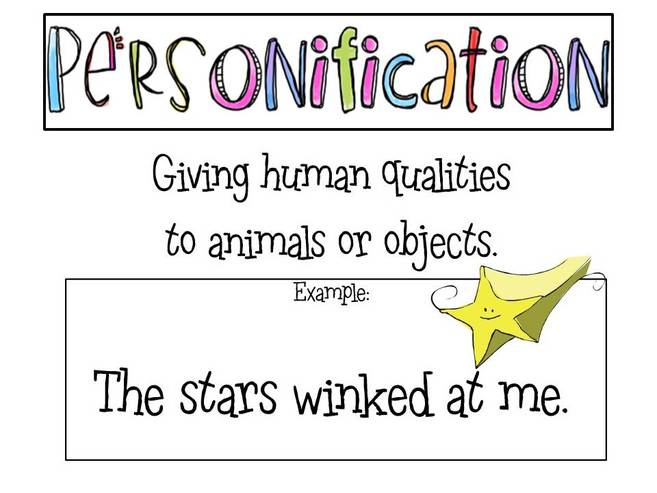
Warm-Up: Work on 100 Word Challenge Story Let's begin today by taking some time to work on our 100 Word Challenge: Rememberwriting pieces, which are to be published tomorrow. Please pay close attention to your spelling, capitalization, punctuation, and verb tenses (more to come later today about this). Personification in Poetry We are going to continue our exploration of poetry today by examining the use of personification in two different poems. For a reminder on what personification is and why poets use it, check out the infographic below.
As you read today's poems, be on the lookout for personification, as the poets work to give human qualities to things that are decidedly non-human. Record your analysis of personification using the document Personification in Poetry, which can be found in your Language Arts folders.
Writing Mini-Lesson: Verb Tenses When you write a narrative, a general rule of thumb is to use one consistent verb tense. For example, if you begin telling a story using the past tense, you should maintain the past tense throughout your story. What you don't want to do is shift from one tense to another without clear reasoning. For example, you don't want to start telling a story in the past tense, shift to the present, and then back to the past again. However, several of you have received comments from your international writing mentors asking you to take a look at your use of inconsistent verb tenses. Here's a sampling:
Notice that each of the student writers addressed above received positive feedback but had similar issues with their verb tenses. Now let's take a look at a few writing samples from these students and see if we can help them make their use of verb tenses more consistent.
Discuss with your teammates: What simple changes in verb tenses could we make in each story to make them more effective? Also, have a conversation about why it's important to use consistent verb tenses when telling a story. Be prepared to share out.
Today's Learning Objectives To understand and appreciate poetry and understand the poet's use of sound devices (rhyme, repetition, rhythm).
Sound Devices in Poetry: Overview Today we will read two different poems that rely on various sound devices to add to the feeling and meaning of the poem. As we read each poem, you will make note of the various sound devices (rhyme, rhythm, and repetition) using the document Sound Devices in Poetry, which can be found in your Language Arts folders. To understand more about sound devices in poetry, check out the 'Focus Your Reading' information below.
Rhyme and Repetition in "Still I Rise" by Maya Angelou We will begin today by reading the poem "Still I Rise" by the extraordinary poet Maya Angelou. Pay close attention to Angelou's use of rhyme in the poem. Do you think there is significance in the pairs of words that do rhyme? Also, look out for repetition. Is there a word or phrase that you see repeated over and over again? Why might that be significant? How does Angelou's use of rhyme and repetition add to the overall feeling and meaning of the poem?
Rhythm in "Casey at the Bat" by Ernest Lawrence Thayer Now we will read the classic baseball poem "Casey at the Bat," which has a distinct rhythmic quality from start to finish. Do you notice the pattern of stressed and unstressed syllables employed by Ernest Lawrence Thayer? How does Thayer's use of rhythm add to the feeling and meaning of the poem?
Homework (1.)Read your A.R. book at home for at least 30 minutes and make a Digital Reading Log entry. (2.) Complete the assignment Sound Devices in Poetry, which will be due on Friday, November 14.
How will you remember the men and women in uniform who have served our country this Veterans Day?
Warm-Up: Metaphor and Simile Quiz Happy Monday! It's time to demonstrate what you learned last week about figurative language, similes, and metaphors. You can find the quiz here. If you finish early, you may silent read or take an A.R. quiz. 100 Word Challenge: A Prompt to 'Remember' Tomorrow is Veterans Day. It's a day in which we as Americans take a moment to remember the brave men and women in uniform who have served, fought, and sometimes died on behalf of our country. In other parts of the world tomorrow is Remembrance Day, whereby war veterans and their sacrifices will be similarly honored and remembered. In light of this important time, in which citizens all around the world stop to give thanks and remember the important contributions of the men and women who have served in uniform, this week's 100 Word Challenge seeks to shine a light on the soldiers and their families who have sacrificed so much. This week's prompt can be found below.
Before we begin to brainstorm about how we will address the prompt and what kind of writing we want to create, let's take a moment to understand why it's so important to remember the sacrifices made by our men and women in uniform and their families. Please watch the video below.
How will you address this week's prompt in your writing? What form will your remembrance take? Will you write a narrative story, a fictional letter, a poem, or perhaps a heartfelt tribute to an actual serviceman, servicewoman, or veteran in your own life.
If writing a narrative, from whose point-of-view will you tell your story? You could obviously tell your story in either third-person or first-person. If writing your story in first-person, consider writing as a soldier in the heat of battle or as veteran looking back and remembering his or her experiences. You could be a deployed parent, husband, or wife remembering his family back home or you could be a husband, wife or child thinking of their loved one away at war. Writing as a soldier, veteran, spouse, or child, you may have suffered an unimaginable loss and choose to remember the comrade or loved one that you lost.
While we may disagree sometimes about whether wars are worth fighting, I think we can all agree that the brave men and women who serve and their families back home are deserving of our gratitude and respect. So please be respectful in your writing and treat this prompt with the seriousness it deserves.
Below I've included some of the images and faces of war, including: combat soldiers, wounded warriors, worried family members back home, grief-stricken spouses and children of the fallen, and mournful veterans who know first-hand the costs and sacrifices of war. Perhaps in one of their faces you see a story that you want to tell.
Soldiers storm the beaches of Normandy on D-Day in World War II.
A soldier writes a letter home. What do you imagine he's writing about?
Heroism on display as soldiers refuse to leave a fallen comrade behind.
What do you suppose this soldier has experienced? What story might he have to tell?
Melissa Stockwell was the first female American soldier in history to lose a limb in active combat and was the first Iraq War veteran to compete in the Paralympic Games as a swimmer in 2008.
A young girl holds a doll bearing the picture of her father who is serving in Iraq.
A soldier's wife worries about her husband deployed overseas.
Grief and loss.
A young boy receives the flag from his father's casket.
What do you imagine this veteran is remembering?
A Vietnam War veteran remembers his fallen comrades at the Vietnam War Memorial.
A veteran against war.
Homework (1.)Read your A.R. book at home for at least 30 minutes and make a Digital Reading Log entry. (2.)Get started on your 100 Word Challenge: Rememberwriting piece. We will be publishing on Friday, November 14.
100 Word Challenge: Finishing Touches and Publishing Aloha Friday! Before we publish our 100 Word Challenge stories, take one last moment to carefully review your writing. At the very least, make sure your spelling, capitalization, and punctuation are as good as they can be. Here is additional piece of advice provided by one of our mentor writing teachers to one of you on a recent blog post:
Next, it's publishing time! Copy your story from your Google Doc and then login toKidblog. Make a new post. This week you once again get to title your story whatever you find fitting; just make sure you put 100 WC: before your chosen title. Paste your story. Finally, click "Publish".
Next, copy the web address of your posted story and then head over to 100 Word Challenge. Scroll down and paste the web address into the box that says 'Blog Link'. Enter your first name, 6th Grade, Lakeview Middle School, and for location: Watsonville, California, U.S.A. Finally, click 'Submit'. Congratulations! You have published yet another story. I can't wait to hear about the feedback you receive.
Identifying Similes and Metaphors in Music Let's spend the remainder of our time today listening and grooving to our favorite music! However, remember that we also have an academic purpose for this. Our task today is to identify and analyze the use of similes and metaphors in some of our favorite songs. As you listen to each song, record it's title, provide an example of figurative language featured in the song, indicate whether that example is a simile or metaphor, explain what is being compared, and include a short analysis of why you think the songwriter is making the comparison. You can find the assignment Similes and Metaphors in Music in your Language Arts folders. Homework (1.)Make sure you read for 30 minutes at least once over the weekend and make an entry on your Digital Reading Log. I will be grading this week's Reading Log on Monday, November 10. (2.) We will be having a short quiz on Metaphors and Similes on Monday. Are you prepared?
What do Justin Bieber and a croaking frog have in common? Find out today in the poem "I'm Nobody! Who Are You?" by Emily Dickinson.
Today's Learning Objectives To understand and appreciate poetry and understand the use of figurative language in a poem.
Examining the Use of Similes and Metaphors in Poetry Today we will read three different poems by three different poets. Our objective is to try our best to understand and appreciate each poem, while also going deeper as poet Billy Collins would want us to do.
Each poem you read today features figurative language, especially similes and metaphors. As you examine each poem closely, be on the lookout for the use of similes and metaphors. Additionally, think about what is being compared in the identified simile or metaphor, how those two things are alike, why the poet makes this comparison, and what effect it has on you the reader? You will record your analysis using the document Similes and Metaphors in Poetry, which can be found in your Language Arts folders. (This assignment will not officially be due until next Friday, November 14.)
Musical Homework Assignment Poetry is not the only place you can find figurative language, such as similes and metaphors. Songs feature them too. Check out a few examples below.
Tomorrow we will be examining the use of similes and metaphors in music. One of your homework assignments tonight is to select one of your favorite songs that features either a simile, a metaphor, or both. We will be listening to various songs tomorrow, so make sure your choice is appropriate for classroom listening. Please share your selection with me using the Google Form here. You may submit more than one song if you choose. Homework (1.)Read your A.R. book at home for at least 30 minutes and make a Digital Reading Log entry. (2.) Find one song that contains a metaphor or simile and share it on Google Form listed above. (3.) Make sure the followings assignments from the week are completed by tomorrow, Friday, November 7:Similes and Metaphors - Independent Practice and 100 Word Challenge: as it shivered, they(we are publishing tomorrow). (4.) Complete the assignment Similes and Metaphors in Poetry,which is not officially due until next Friday, November 14.
Today's Learning Objectives To understand and appreciate poetry and understand the use of figurative language.
Introduction to PoetryYesterday we learned that trying to define poetry is no easy task. You probably recognize poetry, when you see it, even if you can't really explain what poetry is. To understand a poem, you need to think about the way the words look on the page, the way the words sound together, and the images, or mental pictures, the create.
Poet Billy Collins, in his aptly titled poem "Introduction to Poetry, cautions readers against trying to simply understand or "figure out" a poem's surface meaning, but rather encourages us as readers to go deep "inside a poem" and feel and experience it. Let's begin today by feeling and experiencing Billy Collins' poem below.
Key Elements of Poetry: Figurative Language To truly experience poetry as Billy Collins encourages us to do, we need to pay attention to the shapes, sounds, and the images in a poem. Furthermore, we need to understand and appreciate that poetry is composed of various elements, which include form, sound, imagery, and figurative language.
Today we are going to focus on figurative language, with a special emphasis on similes and metaphors. Let's now read an excerpt from our textbook explaining what figurative language is and some of the various types below.
Next, let's more closely examine metaphors and similes. How are they alike? How are the different? Watch the short video below.
1. Locate your Apps in Google Drive
BrainPop Activities: Similes and Metaphors Now we will continue to explore similes and metaphors with our friends Tim and Moby from BrainPop. First, open your Google Drive. Next, locate your Apps by clicking the group of small squares towards the top of your screen similar to the ones pictured to the side. Then, scroll down and find and click the BrainPop icon.
2. Find and open BrainPop.
3. Search for the 'Similes and Metaphors' Lesson.
Next, type in "Similes and Metaphors" into the search bar, click the lesson,
4. After the video, take the Classic Quiz.
and the close your computer. I will show the video on the "Big Screen" first as a whole-class. Afterwards, each of your will be able to check your understanding by taking the "Classic Quiz."
Independent Practice: Similes and Metaphors Now that you have a better idea about what similes and metaphors are, let's practice constructing some of our own. In your Language Arts folders, you will find the assignment Similes and Metaphors - Independent Practice. Complete the similes and metaphors by adding your own words. What you do not finish in class becomes homework. Homework (1.)Read your A.R. book at home for at least 30 minutes and make a Digital Reading Log entry. (2.) Complete the assignmentSimiles and Metaphors - Independent Practice, which will be due on Friday, November 7.
Warm-Up: Silent Reading Happy Monday! Please take out your A.R. book and begin a session of silent reading. If you need to take an A.R. quiz, please do so.
100 Word Challenge: Reviewing and Making Comments Many of you have already received a lot of positive feedback about your most recent stories on KidBlog. Take a moment today and review your comments. Read them carefully. What are you doing well in writing? What improvements can you make? Let's also spend some time making comments of our own for other writers. You can find some great advice about how to leave "good comments" here. Review our class's Blogroll for a class or a group of students that you would like to connect with. Use your comments to provide positive feedback, make a suggestion, and forge a connection. You may also consider leaving the address of your KidBlog with your comment to keep the conversation going.
100 Word Challenge: This Week's Prompt This week's prompt can be found below.
Many questions immediately come to mind. First, for the sake of my story I want to better understand the nature of shivering. Who exactly shivers and why? I found this definition below.
I also found this:
So from my research I determined that shivering can be a response to hypothermia, feeling cold, and even a result of fear or excitement. But who will be shivering in my story? We know humans and other warm-blooded animals can shiver. But the pronoun "it" in the prompt, rather than "he" or "she," complicates things. Does "it" refer to an animal, a newborn baby, or possibly a non-human creature or object?
Finally, the reference to "they" makes me wonder, what point-of-view am I telling this story from? Am I telling the story in first-person and providing a first-had account of the actions of others? Or am I telling the story in third-person in which I am not a part of the story, but rather an objective observer, and consistently use third-person pronouns, such as he, she, and they? So before you start to craft your own story you may want to establish same of your story's basic elements. What point-of-view will you be telling the story from? Who is 'it'? Who are 'they'? Why is 'it' shivering? What's the setting? Since the 'shivering' could potentially be the result of cold, you may consider using some of the descriptive adjectives related to cold and winter below. Additional words related to cold and winter can be foundhere.